



Stegosaurus Activities and Printouts
Stegosaurus Facts
- Means: “Covered Lizard” or “Roof lizard”
- Plant eater
- Very small head with a tiny brain and toothless beak
- Large, flat, bony, triangular plates along its back
- A heavy, spiked tail for protection
- Walked on four legs, but the back legs were twice as long as its front legs
Anatomy
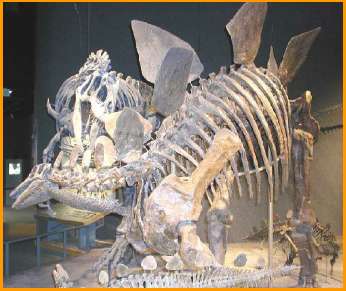
Photo courtesy of Jim Puckett, using a new Olympus 3040 digital camera taken in the Dinosaur Hall of “Prehistoric Journey” at the Denver Museum of Nature and Science
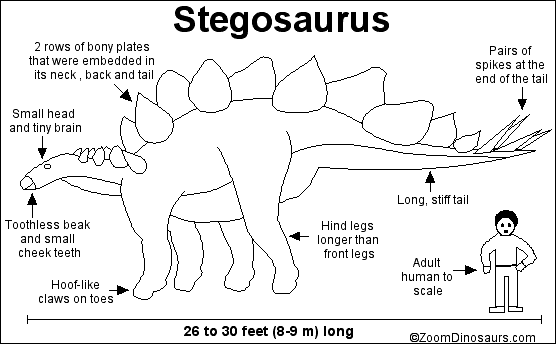
Stegosaurus was up to 26-30 feet long (8-9 m), about 9 feet tall (2.75 m), and weighed about 6,800 pounds (3100 kg). Its small brain was only the size of a walnut (weighing roughly 2.5 - 2.9 ounces (70 - 80 grams). Its skull was long. pointed, and narrow; it had a toothless beak and small cheek teeth. Its head was carried close to the ground, probably no more than 3 feet (1 m) high.
Stegosaurus had 17 bony plates that were embedded in its back. The arrangement of these plates was unknown until a 1992 Stegosaurus find in Colorado (Carpenter, et al.) - the plates ran along the Stegosaurus’ back and tail in two rows, and the plates alternated in alignment.
The function of these plates is uncertain. The plates were made of bone which was not solid, but was filled with tube-like tunnels. The largest of these triangular plates was about 2.5 ft (76 cm) tall and just as long. The plates were probably well-nourished by blood vessels, indicating that the plates may have been used to regulate the dinosaur’s temperature. They may have also been used for protection or mating display purposes.
Stegosaurus also had spikes at the end of its flexible tail (these are called thagomizers; they were named for a Gary Larson “Far Side” cartoon in which a caveman is explaining that the end of a Stegosaurus’ tail is called a thagomizer, named for the late Thag Simmons). These spikes were up to four feet long and were used for protection from predators; they pointed to the sides of the tail. Different species of Stegosaurus had different numbers of tail spikes; Stegosaurus ungulatis had 8 spikes and Stegosaurus stenops had 4 spikes. Some early Stegosaurus had shoulder spines.
As even more protection, Stegosaurus had armor-like scutes on the skin of the neck, the pelvic area (the hips) and perhaps on the sides of some species. These bony scutes were dicovered by Carpenter, et. al. in 1992.
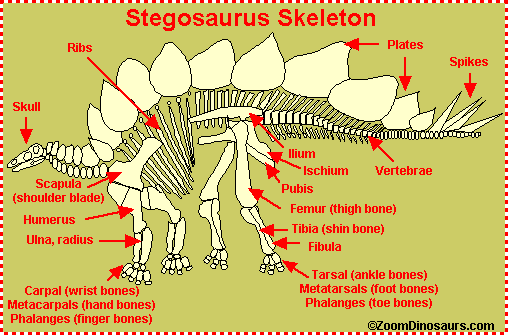
Stegosaurus’ rear legs were longer and straighter than its front legs, which sprawled out to the sides. The forefeet (the feet of the front legs) had five short, wide toes with short, hoof-like tips. The rear feet had three short, wide toes with hooves.
Diet and Teeth
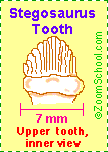
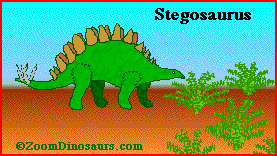 This plated dinosaur was an herbivore (it ate only plants). It must have eaten a large amount of low-calorie plant material each day to sustain its bulk, probably using its toothless beak to get food. There is debate on whether or not Stegosaurus could rear up on its rear legs to forage for vegetation. If it couldn’t rear up, it was limited mostly to plants no taller than about 3 feet (1 m) tall. This would have included ferns, smaller club mosses, cycads, horsetails, and bushy conifers.
Predators of Stegosaurus
It isn’t known with any certainly, but possible predators of Stegosaurus include all the large meat-eaters from western North America during the late Jurassic Period, about 156-140 million yeas ago (where and when Stegoaurus lived). Some of these meat-eaters included Allosaurus, Ceratosaurus, Marshosaurus, Torvosaurus, and maybe even packs of smaller meat-eaters like Ornitholestes.
Stegosaurus’ Plates
 Stegosaurus’ many plates were embedded with a network of blood vessels. This suggests that these plates were probably used for the collection and dispersion of heat. If Stegosaurus used the plates to regulate its body heat, then Stegosaurus was ectothermic (cold-blooded).
When Stegosaurus Lived

 Stegosaurus lived during the late Jurassic Period, about 156-140 million years ago. There was no polar ice during the last two-thirds of the Jurassic. The climate was warm and moist and the sea levels high. There were vast flooded areas, temperate and subtropical forests, and coral reefs. The extensive water moderated the seasonality.
There was a minor mass extinction toward the end of the Jurassic period. During this extinction, most of the stegosaurid and enormous sauropod dinosaurs died out, as did many genera of ammonoids, marine reptiles, and bivalves. No one knows what caused this extinction.
Locomotion
Stegosaurus’ back legs were twice as long as its front legs. It is generally though to have walked on all four legs (quadtupedal), but it may have reared up on its large hind legs to get vegetation.
Behavior
Stegosaurus, like other Stegosaurians, may have been a herding animal, but this is far from certain.
Intelligence
Stegosaurus had a very tiny brain - it was only the size of a walnut. This is especially small, given that Stegosaurus was up to 26-30 feet (8-9 m) long! It used to be thought that Stegosaurus had a second brain (which it would seem to need given that the brain in its head was very, very tiny). Paleontologists now think that what they thought was a second brain was just an enlargement in the spinal cord in the hip area. This enlargement was larger than the animal’s tiny brain. There is debate about what this enlargement contained - fatty tissue or nerves. This sacral ganglion, larger than the animal’s tiny brain, may have contained both nerves and fatty tissue. This nerve center may have controlled the animal’s hind legs and tail.
Stegosaurus was a stegosaurian (stegosaur), whose intelligence (as measured by its relative brain to body weight, or EQ) was relatively low among the dinosaurs.
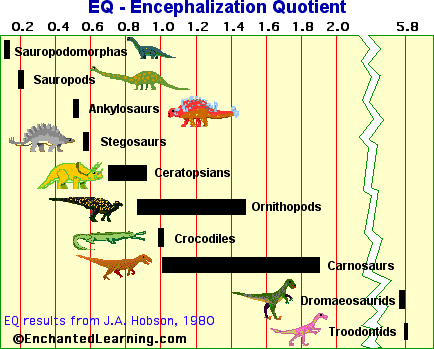
Discovery of Fossils
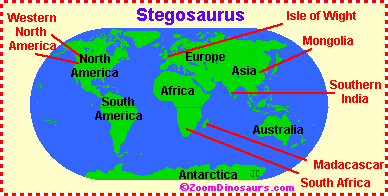 Many fossils of Stegosaurus have been found in western North America (Utah, Wyoming, and Dinosaur Ridge, Colorado), western Europe, southern India, China, and southern Africa. The first Stegosaurus fossil was found in Colorado, USA, in 1876 by M. P. Felch. Paleontologist Othniel C. Marsh named Stegosaurus in 1877. The most complete Stegosaurus yet found (nicknamed Spike) was discovered near Canon City, Colorado, USA in 1992 by Bryan Small, Tim Seeber, and Kenneth Carpenter. Only one set of Stegosaurus footprints have been found so far, and they were stolen from Western Australia in 1996.
Classification
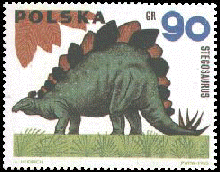 Stegosaurus was an herbivorous ornithischian dinosaur, belonging to the group Thyreophora (also called Enoplosauria, they were dinosaurs with dermal armor, including both the stegosaurs and the ankylosaurs, as well as some others) and the group Stegosauridae (which includes Kentrosaurus, Tuojiangosaurus, and others). Stegosaurus was the largest and one of the last of the stegosaurids. The type species is S. armatus.
Printouts and Activities
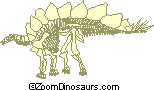
- Stegosaurus fact sheet or a printable version
- A Stegosaurus page to print out
- Print out a K-3 level Stegosaurus info page to color!
- Paint a Stegosaurus online - an interactive coloring book.
- Print out a labeled Stegosaurus skeleton
- Stegosaurus Find It! Quiz to print out for grades 2 to 3.
- A first-grade level Stegosaurus addition activity print-out.
- A Stegosaurus word hunt activity - For second and third graders.
- An on-line quiz about Stegosaurus - answer the questions and you will unscramble the Stegosaurus picture! On-line activity for grades 2-4.
 Make a paper Stegosaurus finger puppet.
- A Stegosaurus Activity print-out for beginning readers (advanced first graders to second graders). Students read and follow the directions to complete a Stegosaurus scene.
- A quiz about Stegosaurus - Unscramble the answers and see how much you know about Stegosaurus! A print-out for grades 2-3.
- Make a Stegosaurus cake.