
|
 Table of Contents |
Enchanted Learning ALL ABOUT BUTTERFLIES! |
Butterfly Calendar |
| What is a Butterfly? | Life Cycle | Butterfly Anatomy | Information Sheets | Glossary | Printables and Activities |
| Butterfly Glossary |
| A | B | C | D | E | F | G | H | I | J | K | L | M | N | O | P | Q | R | S | T | U | V | W | X-Z |
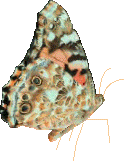 PAINTED LADY BUTTERFLY Vanessa cardui is a widespread butterfly in temperate and some tropical areas. It also known as the thistle butterfly and the cosmopolitan. The Painted Lady has a 2 - 2 7/8 inches (5.1 - 7.3 cm) wingspan. Adults sip thistle nectar and some hibernate. The life cycle begins with tiny, pale green eggs. The yellow-striped, brown-green spiny caterpillar builds a silky, webbed nest, usually in thistle. Family: Nymphalidae |
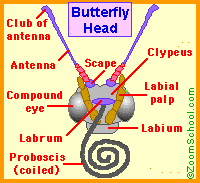 PALPS Palps are the mustache-like scaly mouthparts of adult butterflies that are on each side of the proboscis. These jointed palps are covered with sensory hairs and scales. The palps test whether something is food or not. |
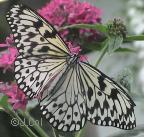 PAPER KITE BUTTERFLY The paper kite butterfly, also called the rice paper butterfly, tree nymph butterfly, or wood nymph (Idea leuconoe) is a distinctive black and white butterfly. The wingspan is 95 to 110 cm across. The chrysalis is yellow with black markings. It is from Southeast Asia. Classification: superfamily Papilionigiae, family Nymphalidae, subfamily Danainae, Genus Idea, Species I. Leuconoe. |
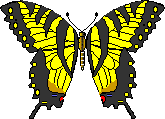 PAPILIONIDAE Papilionidae are a family of butterflies that contains swallowtail and birdwing butterflies. They are strong fliers with three fully developed pairs of legs. Many swallowtails have distinctive tailed wings (hence the family name). They lay spherical eggs. These butterflies are found from the tropics to more temperate regions. |
PARASITE A parasite is an organism (a plant or animal) that lives on another organism (the host), obtaining nutrition from it and sapping or killing the host. |
PARASITISM Parasitism is arelationship between two organisms in which one organism benefits at the other organism's expense. Lice are an example of a parasite that affects many animals; termites are a parasite that are destructive to many trees. Parasitism is a type of symbiosis. |
PARASITOID A parasitoid is an organism (a plant or animal) that lays its eggs in or on another living organism (the host). The eggs hatch and feed on the live host tissue. Some wasps are parasitoids; they lay their eggs in a caterpillar's body. When the eggs hatch, they feed on the caterpillar and eventually kill it. |
PARSIMONY Parsimony is the scientific idea that the simplest explanation of a phenomenon is the best one. |
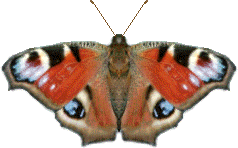 PEACOCK BUTTERFLY The peacock butterfly (Inachis io) is a common butterfly from temperate parts of Europe (including Britain) and Asia. This butterfly makes a hissing sound when it is alarmed (usually upon seeing a bird); it makes the sound by rubbing its wings together. The wings are brownish-purple with a bright eyespot on each wing (the wings look a bit like an owl's face). The undersides of the wings are mottled grayish-brown. The larval host plant is the stinging nettle; the caterpillar is black with spines. Classification: Family Nymphalidae (brush-footed butterflies), genus Inachis, species I. io. |
PENNSYLVANIAN PERIOD The Pennsylvanian Period lasted from 325 to 280 million years ago. During this time, the first reptiles (like Hylonomus) appeared and ferns dominated the warm, swampy landscape. |
PERIOD The period is the basic unit of geological time in which a single type of rock system is formed, lasting tens of millions of years. |
PEPPERED MOTH The peppered moth (Biston betularia) is a common moth that is used as a common example of observable natural selection. In England in the 1880's, soot covered much of the landscape, following the advent of the Industrial Revolution. Previous to the soot problem, the light-colored variety of the moth (called typis) was common in England (its speckled coloration helped camouflage the moth when perched on birch tree trunks). After pollution covered many of the trees with a dark layer of soot and killed the light, whitish-gray colored lichens that lived on the tree trunks, a dark form of the moth (called carbonaria) was observed (presumably since the light-colored variety was no longer camouflaged when at rest on trees, and they were caught by birds - the dark-colored variety were now better camouflaged and more likely to survive and reproduce). The dark form of the peppered moth was first observed in 1848, and by 1895, 95 percent of the peppered moths were of the darker type. Recently, as cleaner-burning fuels have been used in England, the light-colored variety has returned to prominence. This phenomenon is called "industrial melanism." |
 PERMIAN PERIOD The Permian period (named after the Perm Province in northeast Russia where rocks from this period were first described) is known as "The Age of Amphibians" (280 to 245 million years ago), this is when Pangaea formed and Earth's atmosphere was oxygenated to modern levels. It ended with the largest mass extinction and was followed by the Triassic period of the Mesozoic Era. |
PHARYNX The pharynx is the front part of the foregut between the mouth and the esophagus. |
PHEROMONE Pheromones are chemicals secreted by some animals that cause specific reactions in other animals. Some animals. like moths, use pheronomes to attract mates. |
PHOTOSYNTHESIS Photosynthesis is the process in which plants convert sunlight into food energy (sugars and starches). |
PHOTOTAXIS Phototaxis is the movement of an organism toward or away from light. Moths exhibit phototaxy; they are attracted to light. Males moths are more strongly attracted to light than females. |
PHYLOGENY Phylogeny is the evolutionary relationship between organisms. The phylogeny of an organism reflects the evolutionary branch that led up to the organism. |
PHYLUM In classification, a phylum is a group of related or similar organisms. A phylum contains one or more classes. A group of similar phyla (the plural of phylum) forms a Kingdom. |
PINE BEAUTY MOTH The pine beauty moth (Panolis flammea) is a common cutworm found in Britain pine woodlands; it is considered a forest pest. The wings are mottled brown, tan, and white - the body is fuzzy and light brown (it is camouflaged on pine bark). The host plant is the Scottish lodgepole pine (Pinus contorta); the caterpillar (larva) of the pine beauty moth eats the pine's leaves, defoliating the tree. Classification: Lepidoptera, Noctuidae, Panolis flammea |
PIERIDAE Pieridae is a family of butterflies. This family includes the sulphurs and whites. There are over 1,000 species worldwide. |
PINACULUM Pinaculum (pl. pinacula) are dark, flattened plates on a caterpillar's body that bear the setae (tactile hairs). |
  POIKILOTHERMS Poikilotherms are animals whose internal temperature changes depending on the environment. |
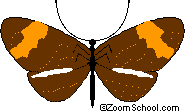 POSTMAN BUTTERFLY Heliconius melpomene is a poisonous butterfly from neotropical habitats in Central America to Brazil. This butterfly has long antenna, and wings that are brown with orange spots. They have a wingspan of 2.5 to 3.25 inches (6 to 8 cm). The caterpillars eat passion vines (Passiflora). Family: Nymphalidae, genus Heliconius, species H. melpomene. |
PREDATOR A predator is an animal that attacks and eats other animals. Birds are predators; many eat butterflies and moths. |
PREPUPA A prepupa is the last larval instar of an insect after it stops eating. During this period, the insect is resting and looks shriveled up and may even appear to be dead. |
PREY An animal is prey when another animal hunts and kills it for food. |
PROBOSCIS The proboscis is a a tube-like, flexible "tongue" that butterflies and moths use to sip their liquid food (usually flower nectar or the liquid from rotting fruits). The proboscis uncoils to sip food, and coils up again into a spiral when not in use. It consists of two halves which are joined together. The lepidopteran with the longest proboscis is the hawk moth. |
  PRODUCER A producer (or autotroph) is an organism that makes its own food from light energy (using photosynthesis), or chemical energy (using chemosynthesis). Most green plants, many protists (one-celled organisms like slime molds) and most bacteria are producers. Producers are the base of the food chain. |
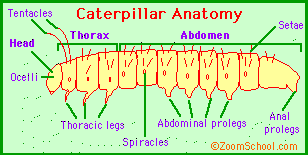 PROLEG A proleg is one of the peg-like legs on the abdomen (hind region) of a caterpillar. These legs have crochets (small hooks) on them. These legs disappear in the adult. |
PUDDLING When a butterfly lands on the ground and sips water from a puddle, it is called puddling. At the muddy or sandy puddle (often located near animal dung), the butterfly sips water rich in mineral salts and other essential nutrients (mostly sodium chloride and nitrogen-rich solutions) that have leached from the surrounding soil and rocks. Male butterflies do more puddling than females. The dissolved salts and minerals may be used to make pheromones (that the male uses to attract females) and sperm. |
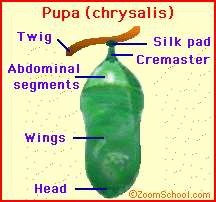 PUPA The pupa is the stage in a butterfly's (or moth's) life when it is encased in a chrysalis and undergoing metamorphosis. It does not eat during this stage. It is outwardly inactive, but a lot is going on inside; the caterpillar is changing into a butterfly. The pupa stage lasts from a few days to many months (some butterflies overwinter in the pupa stage, and the adult emerges in the spring). |
PUPATE To pupate is to turn into and exist as a pupa. |
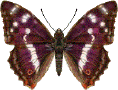 PURPLE EMPEROR BUTTERFLY Apatura iris is a widespread butterfly found in temperate woodlands in Asia and Europe. This powerful flier has a 2 1/2 - 3 inches (6 - 7.5 cm) wingspan. The plump caterpillar is green and tapered at the ends; it eats willow (Salix). The adult male is iridescent purple with white spots and brown margins; there is an range, black and purple eyespot on the lower part of each wing. Adult females are deep brown with white markings. The undersides of both male and female are light brown with tan and white spots, edged in white. Family: Nymphalidae |
|
Butterfly Glossary |
|
|||||
| A | B | C | D | E | F | G | H | I | J | K | L | M | N | O | P | Q | R | S | T | U | V | W | X-Z |
Enchanted Learning®
Over 35,000 Web Pages
Sample Pages for Prospective Subscribers, or click below
|
Overview of Site What's New Enchanted Learning Home Monthly Activity Calendar Books to Print Site Index K-3 Crafts K-3 Themes Little Explorers Picture dictionary PreK/K Activities Rebus Rhymes Stories Writing Cloze Activities Essay Topics Newspaper Writing Activities Parts of Speech Fiction The Test of Time
|
Biology Animal Printouts Biology Label Printouts Biomes Birds Butterflies Dinosaurs Food Chain Human Anatomy Mammals Plants Rainforests Sharks Whales Physical Sciences: K-12 Astronomy The Earth Geology Hurricanes Landforms Oceans Tsunami Volcano |
Languages Dutch French German Italian Japanese (Romaji) Portuguese Spanish Swedish Geography/History Explorers Flags Geography Inventors US History Other Topics Art and Artists Calendars College Finder Crafts Graphic Organizers Label Me! Printouts Math Music Word Wheels |
Click to read our Privacy Policy
| Search the Enchanted Learning website for: |