
|
| You might also like: | Dino News-ZoomDinosaurs.com | Today's featured page: Marvelous Masks |
 |
ZoomDinosaurs.com Dinosaur News |
| Go to a Gallimimus Fact Sheet | September 7, 2001 |
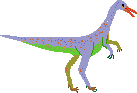 Gallimimus was an ostrich-like dinosaur that had a long tail. A new fossil find in Mongolia indicates that Gallimimus ate by sieving tiny bits of food (like small crustaceans, insects, and plant material) from mud and water in streams and ponds by using comb-like plates in its mouth (like a modern-day flamingo). This is the first time that this type of feeding structure has been found in a dinosaur.
Peter J. Makovicky, a vertebrate paleontologist with the Field Museum in Chicago, Illinois, USA, discovered the 70-million-year-old Gallimimus bullatus fossil in the Gobi Desert.
Ornithomimids: Gallimimus was an ornithomimid (bird-mimic) dinosaur, a group of dinosaurs that were ostrich-like but had a long tail. They had short arms with three clawed fingers on each hand, long legs with three clawed toes on each leg, and hollow bones. A long tail acted as a counterbalance and as a stabilizer during fast turns. Many ornithomimids swallowed stones that served as gastroliths (stomach stones), grinding up tough food like plants and hard-shelled animals. Early ornithomimid dinosaurs (ornithomimosaurs like Pelecanimimus) had hundreds of teeth, later versions (like Anserimimus) had only a few teeth, and the most advanced ornithomimids (like Gallimimus) had a toothless beak.
Gallimimus was a fast-running dinosaur with a very long, thin, flattened, toothless, horny beak, a small head, and a relatively large brain. The bottom front part of its beak was shaped like a shovel. It had large eyes positioned on opposite sites of its head, ruling out binocular vision (depth perception). It had a long neck, long tail, and long legs. Gallimimus was about 13-20 ft (4-6 m) long, was 6.3 ft (1.9 m) tall at the hips, and may have weighed about 970 pounds (440 kg).
Reference: Nature, Aug. 30, 2001.
RELATED LINKS
A page on the dinosaur Gallimimus.
A brief fact sheet on Gallimimus.
A page on the Cretaceous period, when Gallimimus lived.
Other fossils found in Asia.
Enchanted Learning®
Over 35,000 Web Pages
Sample Pages for Prospective Subscribers, or click below
|
Overview of Site What's New Enchanted Learning Home Monthly Activity Calendar Books to Print Site Index K-3 Crafts K-3 Themes Little Explorers Picture dictionary PreK/K Activities Rebus Rhymes Stories Writing Cloze Activities Essay Topics Newspaper Writing Activities Parts of Speech Fiction The Test of Time
|
Biology Animal Printouts Biology Label Printouts Biomes Birds Butterflies Dinosaurs Food Chain Human Anatomy Mammals Plants Rainforests Sharks Whales Physical Sciences: K-12 Astronomy The Earth Geology Hurricanes Landforms Oceans Tsunami Volcano |
Languages Dutch French German Italian Japanese (Romaji) Portuguese Spanish Swedish Geography/History Explorers Flags Geography Inventors US History Other Topics Art and Artists Calendars College Finder Crafts Graphic Organizers Label Me! Printouts Math Music Word Wheels |
Click to read our Privacy Policy
| Search the Enchanted Learning website for: |