



Star classification

The Sun is a as a G2V type star, a yellow dwarf and a main sequence star.
Stars are classified by their spectra (the elements that they absorb) and their temperature. There are seven main types of stars. In order of decreasing temperature, O, B, A, F, G, K, and M.
O and B stars are uncommon but very bright; M stars are common but dim..
An easy mnemonic for remembering these is: “Oh be a fine guy/girl, kiss me.”
Hertzsprung-Russell diagram
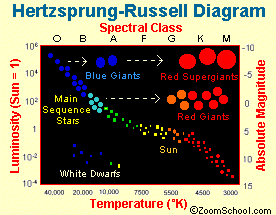 The Hertzsprung -Russell (H-R) Diagram is a graph that plots stars color (spectral type or surface temperature) vs. its luminosity (intrinsic brightness or absolute magnitude). On it, astronomers plot stars’ color, temperature, luminosity, spectral type, and evolutionary stage. This diagram shows that there are 3 very different types of stars:
- Most stars, including the sun, are “main sequence stars,” fueled by nuclear fusion converting hydrogen into helium. For these stars, the hotter they are, the brighter. These stars are in the most stable part of their existence; this stage generally lasts for about 5 billion years.
- As stars begin to die, they become giants and supergiants (above the main sequence). These stars have depleted their hydrogen supply and are very old. The core contracts as the outer layers expand. These stars will eventually explode (becoming a planetary nebula or supernova, depending on their mass) and then become white dwarfs, neutron stars, or black holes (again depending on their mass).
- Smaller stars (like our Sun) eventually become faint white dwarfs (hot, white, dim stars) that are below the main sequence. These hot, shrinking stars have depleted their nuclear fuels and will eventually become cold, dark, black dwarfs.
Spectral classes
| Star Type | Color | Approximate Surface Temperature | Average Mass (The Sun = 1) | Average Radius (The Sun = 1) | Average Luminosity (The Sun = 1) | Main Characteristics | Examples |
|---|---|---|---|---|---|---|---|
| O | Blue | over 25,000 K | 60 | 15 | 1,400,000 | Singly ionized helium lines (H I) either in emission or absorption. Strong UV continuum. | 10 Lacertra |
| B | Blue | 11,000 - 25,000 K | 18 | 7 | 20,000 | Neutral helium lines (H II) in absorption. | Rigel |
| A | Blue | 7,500 - 11,000 K | 3.2 | 2.5 | 80 | Hydrogen (H) lines strongest for A0 stars, decreasing for other A’s. | Sirius, Vega |
| F | Blue to White | 6,000 - 7,500 K | 1.7 | 1.3 | 6 | Ca II absorption. Metallic lines become noticeable. | Canopus, Procyon |
| G | White to Yellow | 5,000 - 6,000 K | 1.1 | 1.1 | 1.2 | Absorption lines of neutral metallic atoms and ions (e.g. once-ionized calcium). | Sun, Capella |
| K | Orange to Red | 3,500 - 5,000 K | 0.8 | 0.9 | 0.4 | Metallic lines, some blue continuum. | Arcturus, Aldebaran |
| M | Red | under 3,500 K | 0.3 | 0.4 | 0.04 (very faint) |
Some molecular bands of titanium oxide. | Betelgeuse, Antares |
Subtypes
Within each stellar type, stars are placed into subclasses (from 0 to 9) based on its position within the scale.
The Yerkes Luminosity Classes: (by William Wilson Morgan and Philip Keenan)
| Type | Star |
|---|---|
| Ia | Very luminous supergiants |
| Ib | Less luminous supergiants |
| II | Luminous giants |
| III | Giants |
| IV | Subgiants |
| V | Main sequence stars (dwarf stars) |
| VI | Subdwarf |
| VII | White Dwarf |
Luminosity is the total brightness of a star (or galaxy). Luminosity is the total amount of energy that a star radiates each second (including all wavelengths of electromagnetic radiation).
In the Yerkes classification scheme, stars are assigned to groups according to the width of their spectral lines. For a group of stars with the same temperature, the luminosity class differentiates between their sizes (supergiants, giants, main-sequence stars, and subdwarfs).
Main sequence stars - young stars
Main sequence stars are the central band of stars on the Hertzsprung-Russell Diagram. These stars’ energy comes from nuclear fusion, as they convert Hydrogen to Helium. Most stars (about 90%) are Main Sequence Stars. For these stars, the hotter they are, the brighter they are. The sun is a typical Main Sequence star.
Dwarf stars
Dwarf stars are relatively small stars, up to 20 times larger than our sun and up to 20,000 times brighter. Our sun is a dwarf star.
Yellow dwarf
Yellow dwarfs are small, main sequence stars. The Sun is a yellow dwarf.
Red dwarf
A red dwarf is a small, cool, very faint, main sequence star whose surface temperature is under about 4,000 K. Red dwarfs are the most common type of star. Proxima Centauri is a red dwarf.
Giant and supergiant stars - old, large stars
Red giant
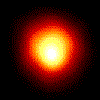 A red giant is a relatively old star whose diameter is about 100 times bigger than it was originally, and had become cooler (the surface temperature is under 6,500 K). They are frequently orange in color. Betelgeuse is a red giant. It is about 20 times as massive as the Sun about 14,000 times brighter than the Sun, and about 600 light-years from Earth.
Blue giant
 A blue giant is a huge, very hot, blue star. It is a post-main sequence star that burns helium.
Supergiant
A supergiant is the largest known type of star; some are almost as large as our entire solar system. Betelgeuse and Rigel are supergiants. These stars are rare. When supergiants die they supernova and become black holes.
Faint, virtually dead stars
White dwarf
A white dwarf is a small, very dense, hot star that is made mostly of carbon. These faint stars are what remains after a red giant star loses its outer layers. Their nuclear cores are depleted. They are about the size of the Earth (but tremendously heavier)! They will eventually lose their heat and become a cold, dark black dwarf. Our sun will someday turn into a white dwarf and then a black dwarf. The companion of Sirius is a white dwarf.
Brown dwarf
A brown dwarf is a “star” whose mass is too small to have nuclear fusion occur at its core (the temperature and pressure at its core are insufficient for fusion). A brown dwarf is not very luminous. It is usually regarded as having a mass between 1028 kg and 84 x 1028.
Neutron star
A neutron star is a very small, super-dense star which is composed mostly of tightly-packed neutrons. It has a thin atmosphere of hydrogen. It has a diameter of about 5-10 miles (5-16 km) and a density of roughly 10 15 gm/cm3.
Pulsar
A pulsar is a rapidly spinning neutron star that emits energy in pulses.
Binary stars
Double star
 A double star is two stars that appear close to one another in the sky. Some are true binaries (two stars that revolve around one another); others just appear together from the Earth because they are both in the same line-of-sight.
Binary star
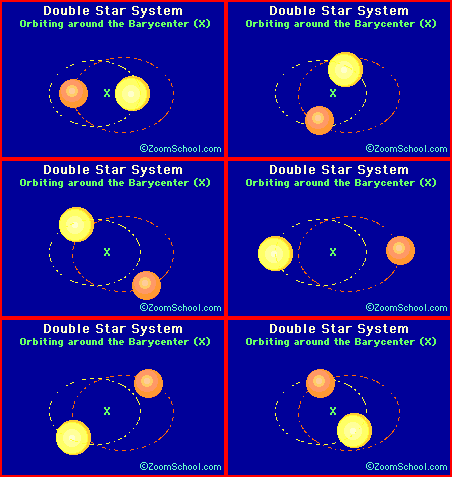 A binary star is a system of two stars that rotate around a common center of mass (the barycenter). About half of all stars are in a group of at least two stars.
Polaris (the pole star of the Northern Hemisphere of Earth) is part of a binary star system.
Eclipsing binary
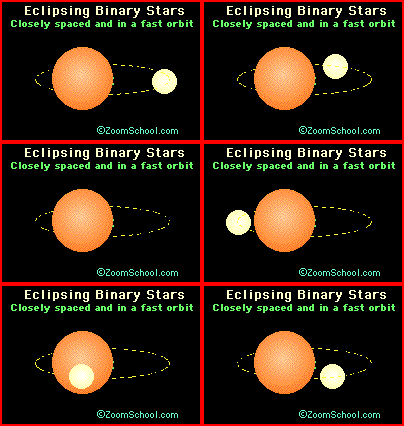 An eclipsing binary is two close stars that appear to be a single star varying in brightness. The variation in brightness is due to the stars periodically obscuring or enhancing one another. This binary star system is tilted (with respect ot us) so that its orbital plane is viewed from its edge.
X-ray binary star
X-ray binary stars are a special type of binary star in which one of the stars is a collapsed object such as a white dwarf, neutron star, or black hole. As matter is stripped from the normal star, it falls into the collapsed star, producing X-rays.
Variable stars - stars that vary in luminosity
Cepheid variable stars
 Cepheid variables are stars that regularly pulsate in size and change in brightness. As the star increases in size, its brightness decreases; then, the reverse occurs. Cepheid Variables may not be permanently variable; the fluctuations may just be an unstable phase the star is going through. Polaris and Delta Cephei are examples of Cepheids.
Mira variable stars
| Some Mira Variable Stars | Magnitude Range | Period (days) |
|---|---|---|
| R Carinae | 3.9-10.5 | 308.7 |
| R Centauri | 5.3-11.8 | 546.2 |
| Mira (Omicron Ceti) |
3.4-9.3 | 332.0 |
A Mira variable star is a variable star whose brightness and size cycle over a very long time period, in the order of many months. Miras are pulsating red giants that vary in magnitude as much as a factor of many hundred (by 6 or 8 magnitudes). Mira variables were named after the star Mira, whose variations were discovered in 1596.